exhibitions
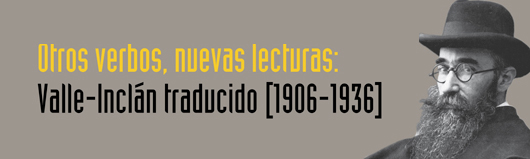
Did Valle-Inclán manage to be an internationally famous writer during his time? If so, where did he have more success? In which languages did they read him more? To which people and entities did he entrust his image abroad? Which was his degree of intervention in the process? Which were his projects and expectations? Which is, in the end, the facet of Valle-Inclán which was more successful overseas (in the case that any succeeded)?
The exhibition Otros verbos, nuevas lecturas: Valle-Inclán traducido [1906-1936] gives answer to all these questions. It is an initiative of the Consello da Cultura Galega and la Cátedra Valle-Inclán of the University of Santiago de Compostela, aimed to enlighten the image of the writer, who was trapped, at the beginning, in the different cultural codes of the places in which he lived and to which he travelled (specially Galicia-Madrid), but at the end managed to form the perfect combination for his literary, artistic and cultural identity at an international level.
After offering a first summary of his career as writer, disclosing specially his relation to the galleguismo and the multiple ways of intervention that he used in the politics, culture and society of his time, the sample is aimed to recover the international echoes that his figure and work provoked, due to both the interest of his contemporaries because of the distinguishing character of his production in the field of Spanish literature, and to the process of cultural intervention in other countries, basically through his journeys abroad and the contact with intellectuals of different origins.
To do so, and thanks to the work carried out during the last years by the Grupo de Investigación Valle-Inclán of the University of Santiago de Compostela, we have managed to gather a corpus with different nuances which, apart from remodelling the list of managers, translators, editors, critics, journals or newspapers, also incorporates new translations of Valle-Inclán published during the life of the author, with their correspondent introductory studies and critical articles on the reception of his figure and works; it recovers the collected letters which he exchanged with some of the agents responsible for the process of publication in other countries, or it even recovers the illustrations and caricatures that accompanied the texts, in all the languages in which he himself got to see his works translated: Bulgarian, Czech, French, Dutch, Hungarian, English, Icelandic, Italian, Latvian, Polish, Portuguese, Romanian and Swedish...
A set of materials and testimonies of which this exhibition offers a significant sample, as a first radiograph of the process of internationalisation of the figure of Valle-Inclán through which we can confirm , on the one hand, the existence of an audience interested fundamentally in his Galician conception of life, art and culture, and, on the other hand, the progressive relevance that his name acquired as an intellectual committed to the international political situation, specially from 1915 onwards, in France, and after, in Russia and Italy.
In a way, these testimonies offer an additional and unpublished perspective of the writer: that of an experienced manager of his work and a connoisseur of the dynamics of the literary field. In this sense, Valle-Inclán is involved in different issues, to which he will give thorough answer: from the advantages and disadvantages of negotiating with big publishing houses, to the importance of personal relationships with diplomats, writers, journalists and scholars of other countries; from the unequal luck of his short narrative, his poetry, essays or theatre, to the omnipresent character of the Sonatas; from the difficulties of the translations derived from the complex historical and linguistic references of his work, to the moral and intellectual peculiarities of the readership; without forgetting, obviously, his certainty about the decisive role of literary and political journalism of his time as an element of dissemination... Thus, the figure and work of Valle-Inclán are displayed through this alternative route of his career, like a complex roundtrip which allows us to observe — in the form of a case study- how our complex cultural products were received and used by other communities during the beginning of the 20th century, with special attention to the most immediate European and transatlantic surroundings.
Accordingly, we offer a new proposal, aimed both to specialists in the field and —above all- to the amateur audience, which will undoubtedly see their vision of the writer altered. There is a fixed vision of him, which is traditionally associated to his more canonical works (the Sonatas and the "esperpento") and to an iconography in which the portrait of an old man with a venerable look prevails, during the last years of his life: the "Gran don Ramón", "eterno"(eternal), with "mirada mística"(mystical look), "barba de santo"(beard of saint), of whom the politician and intellectual Galician Xavier Bóveda already talked about in 1917.
Rosario Mascato Rey, curator
Did Valle-Inclán manage to be an internationally famous writer during his time? If so, where did he have more success? In which languages did they read him more? To which people and entities did he entrust his image abroad? Which was his degree of intervention in the process? Which were his projects and expectations? Which is, in the end, the facet of Valle-Inclán which was more successful overseas (in the case that any succeeded)?
The exhibition Otros verbos, nuevas lecturas: Valle-Inclán traducido [1906-1936] gives answer to all these questions. It is an initiative of the Consello da Cultura Galega and la Cátedra Valle-Inclán of the University of Santiago de Compostela, aimed to enlighten the image of the writer, who was trapped, at the beginning, in the different cultural codes of the places in which he lived and to which he travelled (specially Galicia-Madrid), but at the end managed to form the perfect combination for his literary, artistic and cultural identity at an international level.
After offering a first summary of his career as writer, disclosing specially his relation to the galleguismo and the multiple ways of intervention that he used in the politics, culture and society of his time, the sample is aimed to recover the international echoes that his figure and work provoked, due to both the interest of his contemporaries because of the distinguishing character of his production in the field of Spanish literature, and to the process of cultural intervention in other countries, basically through his journeys abroad and the contact with intellectuals of different origins.
To do so, and thanks to the work carried out during the last years by the Grupo de Investigación Valle-Inclán of the University of Santiago de Compostela, we have managed to gather a corpus with different nuances which, apart from remodelling the list of managers, translators, editors, critics, journals or newspapers, also incorporates new translations of Valle-Inclán published during the life of the author, with their correspondent introductory studies and critical articles on the reception of his figure and works; it recovers the collected letters which he exchanged with some of the agents responsible for the process of publication in other countries, or it even recovers the illustrations and caricatures that accompanied the texts, in all the languages in which he himself got to see his works translated: Bulgarian, Czech, French, Dutch, Hungarian, English, Icelandic, Italian, Latvian, Polish, Portuguese, Romanian and Swedish...
A set of materials and testimonies of which this exhibition offers a significant sample, as a first radiograph of the process of internationalisation of the figure of Valle-Inclán through which we can confirm , on the one hand, the existence of an audience interested fundamentally in his Galician conception of life, art and culture, and, on the other hand, the progressive relevance that his name acquired as an intellectual committed to the international political situation, specially from 1915 onwards, in France, and after, in Russia and Italy.
In a way, these testimonies offer an additional and unpublished perspective of the writer: that of an experienced manager of his work and a connoisseur of the dynamics of the literary field. In this sense, Valle-Inclán is involved in different issues, to which he will give thorough answer: from the advantages and disadvantages of negotiating with big publishing houses, to the importance of personal relationships with diplomats, writers, journalists and scholars of other countries; from the unequal luck of his short narrative, his poetry, essays or theatre, to the omnipresent character of the Sonatas; from the difficulties of the translations derived from the complex historical and linguistic references of his work, to the moral and intellectual peculiarities of the readership; without forgetting, obviously, his certainty about the decisive role of literary and political journalism of his time as an element of dissemination...
Accordingly, we offer a new proposal, aimed both to specialists in the field and —above all- to the amateur audience, which will undoubtedly see their vision of the writer altered. There is a fixed vision of him, which is traditionally associated to his more canonical works (the Sonatas and the "esperpento") and to an iconography in which the portrait of an old man with a venerable look prevails, during the last years of his life: the "Gran don Ramón", "eterno"(eternal), with "mirada mística"(mystical look), "barba de santo"(beard of saint), of whom the politician and intellectual Galician Xavier Bóveda already talked about in 1917.
Rosario Mascato Rey, curator
DATES AND LOCATION
Residencia de Estudiantes
11 de diciembre de 2014 - 8 de marzo de 2015
DOSSIER